Epigaea repens, also called Trailing Arbutus or a Mayflower, heralds winter's end as the first woodland flower to blossom.
Lara May was 9 when she became civilized. It was the year her mom glanced at a B on her report card and said, “Oh … I’m sure you’ll do better next time.” It was the year she cried after scraping her knee on the playground and was mocked for her frailty. The boy who had pushed her down laughed. Her friend, who had a crush on him, laughed. Everyone nearby laughed. The recess aid didn’t do anything. When she told her dad about it, he said, “Kids will be kids. You just have to be tougher.” It was the year one of the sort-of friends she’d been forced to invite to her birthday party found her sketch diary and why, oh why, had she labeled it as such? It was a child’s thing, full of simple drawings that she drew every night. Sometimes it was an object that stood out to her that day – like the deep, dark blue jewel of Mrs. Rowland’s heavy necklace that looked like a magic pendant. Sometimes it was people or events – like her crying on the playground and the faces of the people she no longer considered friends but who circled her like vultures waiting for a sign of weakness. The more she tried to explain that words just didn’t work for her, that she had to get the images out instead, the more they said it was stupid, and they each passed it around and took turns ripping out pages and smearing the pencil as she scrambled, hot tears dripping down her face, to get it back.
“Who keeps a diary with no words?”
“It doesn’t even look like me.”
“Aw, look, her face is as ugly as these scribbles.”
“Why are you crying so much? They’re just silly drawings.”
Lara May didn’t understand. She didn’t understand any of it. But it was the year she set aside childish things like sketches and crying and mistakes, vowed never to do them again, and became mature.
Lara May stopped letting on when she was disturbed or troubled, and soon she stopped being disturbed or troubled. She did exactly what was expected of her, and what she lacked in zeal she made up for in thorough efficiency.
It worked. Teachers no longer sighed at tears, but said to other students, “Why can’t you be more like Lara? She never makes a fuss.” Her parents smiled and praised her accomplishments. “See how good our Lara is?” Her classmates learned she was no longer fun to tease if she didn’t do silly things or react to anything and gave her space. She’s pretty sure she likes being alone. Before long, her fingers stop itching for a pencil and she can just exist. Quiet. Safe. Perfect.
Lara May meets Jasper when she moves out to college. He calls her Mayflower. “They’re pretty. Like you,” he says. She doesn’t get it, but she supposes it’s sweet, in an amusing sort of way.
It’s the day after Lara May brings him to meet everyone. Jasper gets on well with her friends. Her parents approve. He smiles and chats and laughs so easily, just as she knew he would. At first she hangs back, a ghost in her own home. Jasper waves her to join the conversation. So she does. Exchanges a few sentences, tries to smile but it feels stiff and alien on her stoic face and she gets peculiar looks for it. So she withdraws again. But this time it feels strange. Like a second skin that is not quite hers.
When they leave, her mother pulls her aside for a moment. “I think you found a winner, Lara. He’s perfect.”
Perfect.
What does that mean?
Quiet. (Silenced.) Safe. (Invisible.) Perfect. (Controlled. Frozen. Lost.)
“Lara, what’s wrong?” Jasper asks when they get back to school, and his voice is so achingly soft that she shatters. Heaving, wailing sobs claw their way out of her throat unrestrained. An ocean of unshed tears from years spent … she doesn’t even know how to explain where they came from … spill from her raw, red eyes. She does not understand. She does not understand. She does not understand.
Lara May cries and cries and cries and does not remember passing out, but Jasper is still in the chair next to her when she flinches back to reality. “You don’t have to tell me. But take it easy, okay?” he says. The words come out carefully, tiptoeing, and she nods, staring at her shoes instead of his face. She does not trust her scratchy throat to hold her voice, nor her stinging eyes to hold his gaze. Ashamed and broken and confused, she leaves like a proud wolf with its tail tucked between its legs. Defeated.
She waits for the text. When it doesn’t come, she waits for the phone call. When it still doesn’t come, she goes to meet him for their prearranged lunch date. He smiles when she arrives. She feels she does not know how to smile back.
It is not until the next week that she realizes he does not intend to leave. She wonders if she should first. She is not perfect, Jasper is perfect, she is weak and stupid and broken and she does not know why.
For the first time in ten years, her fingers twitch, seeking a pencil.
She draws a mayflower.
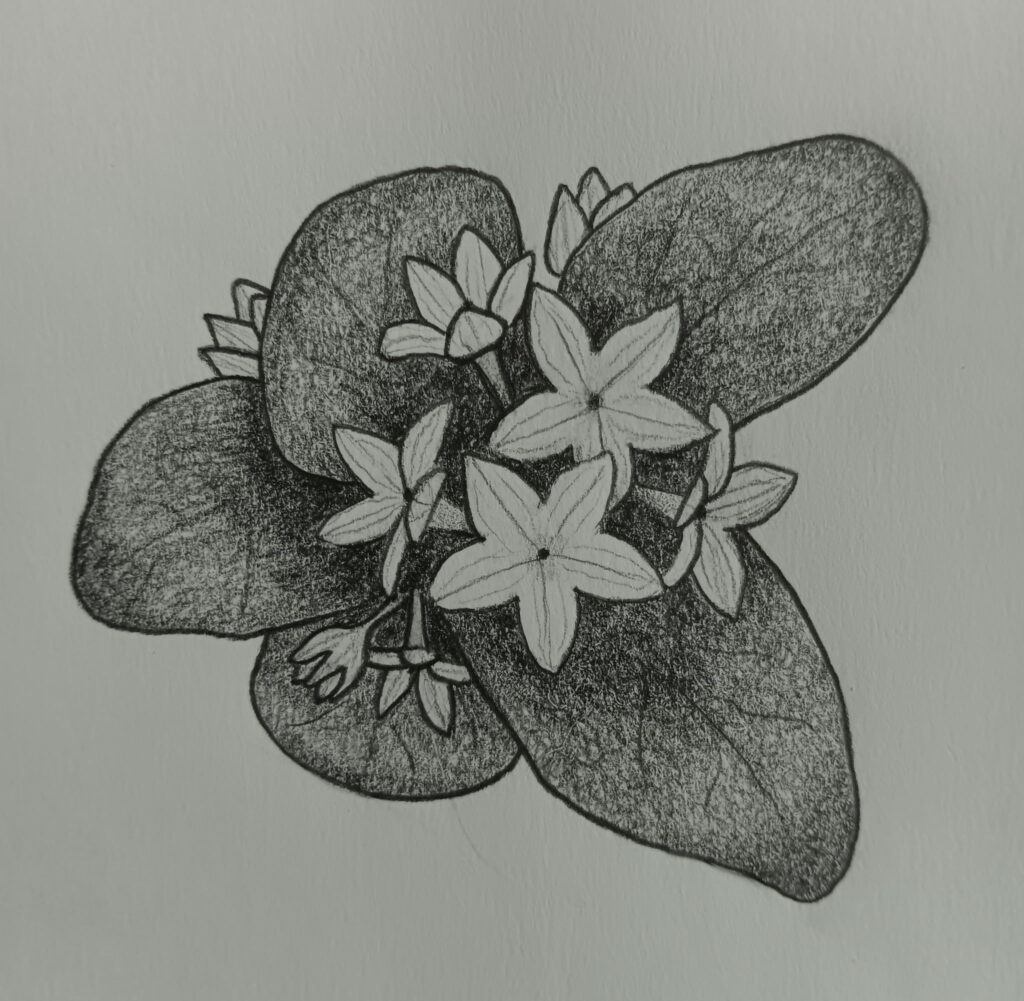
Drawing courtesy of Shauna McLean

Also published in Central Review Volume 22.